
Taboo around male pattern hair loss
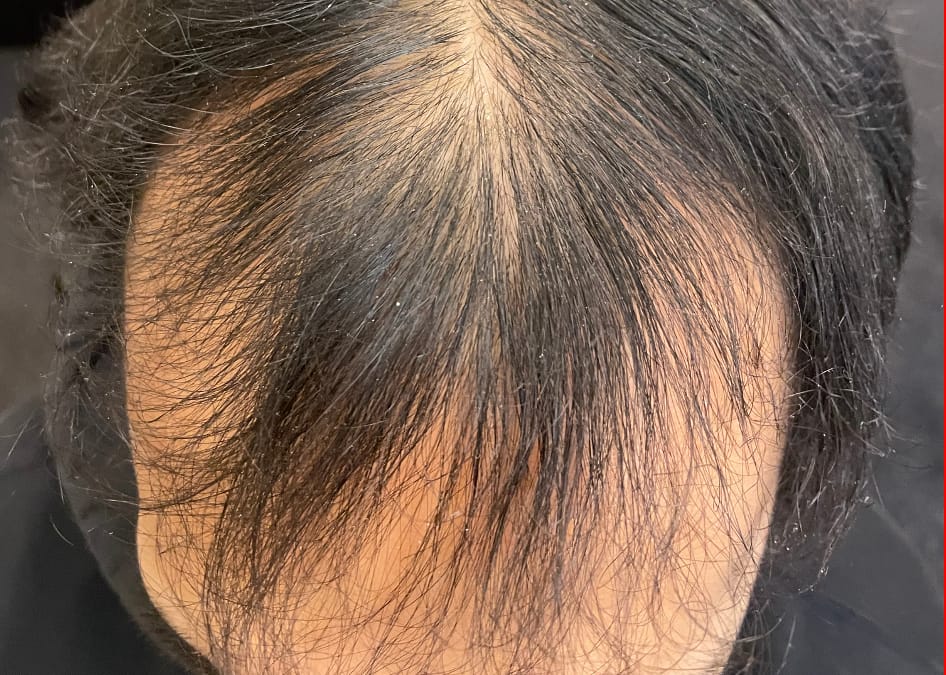
Tackling the taboo around Male Pattern Hair Loss
Eva says; “Hair loss has long been a concern amongst men, yet it’s still something many struggle to talk about. For many, thinning hair or a receding hairline can feel personal, even confronting, as pride, identity, and confidence are often tied to appearance. In the UK alone around 6.5 million men are affected by male pattern hair loss, and by the age of 35, two-thirds of men will notice some degree of thinning or recession.”
“The good news is that we understand more about hair loss now than we have ever before, and knowing which treatments are genuinely effective will put you back in control.”
So, besides ageing, what are the main causes of Male Pattern Hair Loss (MPHL)?
“The causes are broadly grouped as genetic, hormonal, autoimmune, and can be both non-scarring and scarring (which causes permanent hair loss). Both scarring and non-scarring hair loss can be present together. That’s why an accurate, personalised diagnosis is essential – enabling a trichologist to recommend the most appropriate treatment pathway for each patient.”
“When considering the difference between temporary shedding and male pattern baldness, trichologists are educated and highly trained in how to form what is called a “differential diagnosis”. This involves in-depth questions to establish the patient’s lifestyle, diet and medical history, as well as a thorough examination of the hair to identify what is actually happening.”
“In general, temporary shedding presents as “visibly more hair shedding”, where patients discover more hair than usual in the shower, when combing and brushing, and in the plughole or vacuum. The loss tends to be throughout the head, with longer hair becoming thin and ‘straggly’ at the ends and lots of short, newly growing hair found around the temples and hairline. What the patient will often report and feel is ‘hair breakage’.”
“Upon further investigation, a trichologist may find that there is a causative factor which triggered the hair shedding, usually some 3-4 months before noticing the hair falling out. These factors can include illness, infection, stress, poor diet or a new diet (vegetarian, vegan or restrictive – as we’re now seeing regularly with the increased use of GLP-1 injections), medication changes, scalp imbalances and the onset of certain medical conditions.”
“With MPHL, the hair loss follows a recognised pattern, and in most cases, it’s not present across the entirety of the head. Under a trichoscopy, we see hair miniaturisation which is a key identifier of this condition, and in some cases where the pattern has progressed, we also see empty hair follicles. This is not something that is present in temporary shedding.”
“We might consider factors such as genetic inheritance, ageing and sensitivity to testosterone. When free testosterone circulates it binds with the hair follicle and is converted to Dihydrotestosterone (DHT), and it is the DHT that causes hair miniaturisation.”
Do hair DNA tests work?
Eva explains; “Unfortunately, DNA tests used for hair loss are currently unregulated. They should be used as an aid to diagnosis and treatment, not as a standalone tool to provide a definitive diagnosis or treatment plan. I would also describe these tests as “flat”, as they cannot assess what is happening on the scalp in real time. They are unable to diagnose multiple co-existing conditions or account for external factors, which makes them incomplete as diagnostic tools.”
“The test results are also subject to expert interpretation. I’ve seen many patients get a test result that suggests a particular course of hair loss treatment, which in many cases is sold by the provider of the test, which would not yield the desired results of the patient. We know from research and scientific research what works and what doesn’t when it comes to hair loss. Paying for a test to tell you this is somewhat unnecessary and, in many cases, is just another way of charging patients who are already very vulnerable. Hair loss is an emotional issue and it’s a shame to see people taken advantage of due to the lack of regulation in this area.”
How effective are Finasteride and Minoxidil in treating hair loss?
“I use topical Minoxidil in my clinics and see a really good response to this treatment. Some 70% of my patients experience an increase in hair diameter and density and a slowing or stopping of the progression. Finasteride and the natural DHT blocker Serenoa also work very well in many patients. All three are still the first-line treatments used to treat MPHL across the world.”
What is Platelet-Rich Plasma (PRP) and when is it helpful?
“PRP takes blood and spins it to separate it into 3 layers – the red cells sit at the bottom, whilst the growth factors and plasma sit at the top. These are extracted and then injected into the scalp. Individual injections don’t always take as the scalp is tight and difficult to inject into, so using an applicator is usually much more efficient and less painful. The treatments are usually done 6-8 weeks apart over 3 sessions and then maintained every 6-9 months.”
“However, PRP is not suitable for every type of hair loss and is not considered a first-line treatment option. PRP aims to stimulate the hair follicle, increasing hair shaft diameter and reducing shedding. Although PRP can cosmetically thicken the appearance of hair, it does not address or manage the underlying causes of hair loss and is best used as an adjunct to other treatments. Because it uses your own plasma, individual growth factor levels influence the outcome, meaning results can vary significantly between patients. While clever marketing may showcase impressive before-and-after results, it’s important that patients understand PRP may not produce the same outcome for them. Additionally, it requires ongoing commitment and can be costly.”
Looking after your hair from within:
“When it comes to diet, protein is absolutely vital for good hair health. Hair is made of protein and literally craves it. Many of us don’t eat enough protein and if our intake is low the hair may not access it at all, and resort to using stored Vitamin and Mineral levels (particularly stored iron Serum Ferritin and Vitamin B12 and Vitamin D) – avoid processed foods where possible and always stay well hydrated.”
“And, it’s always advisable to consult a trichologist (not a GP!) for an expert review of blood tests to ascertain what is considered a healthy level of certain vitamins and minerals as this is very specific to hair health.”
“I’m so proud to have developed the multi award-winning super supplement, Tricoextra which is hugely popular with both men and women – and is an easy and effective way to take positive steps towards enhancing and nourishing your overall hair health.”
And, how to keep on top of your topical hair and scalp care:
“Poor scalp health can really contribute to hair loss and increased shedding by disrupting the natural hair growth cycle. The scalp acts as the growing medium for hair, so maintaining its balance is essential.”
“Regular cleansing with a suitable shampoo is important – ideally daily, or at least every other day – because the scalp contains around 180,000 oil glands and is naturally moist.”
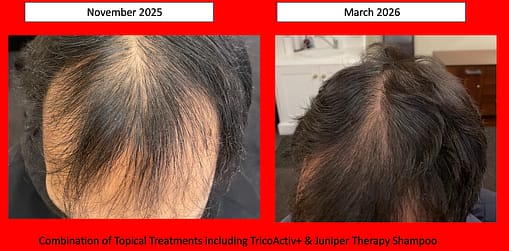
Washing the hair with a good quality shampoo that is effective at cleaning is hugely beneficial and if you have a scalp condition, do get it professionally diagnosed and use an effective management regime to keep it balanced. Seborrhoeic dermatitis is very common with MPHL and can lead to itching, inflammation, and flaking. Shampoos such as Juniper Therapy can be used every day to calm and clear the scalp and to keep it balanced.
“The ‘game-changing’, topical lotion, TricoActiv+ is also being well-received by male customers who are loving the discrete and easy-to-use ‘mode of action’. TricoActiv+ contains a blend of plant-derived ingredients, including rosemary, sandalwood, red clover, hop nettle, and methyl nicotinate, chosen for their well-documented cosmetic and therapeutic properties, helping to support the appearance of thicker, fuller-looking hair and a healthy scalp environment.”
“Overall, the proof of the pudding is in the results! I diagnose and develop individual treatment plans that are reviewed at 4-6 months with clinical photography and microscopy so that the patient can see the results for themselves.”
“Treating hair loss should not be about “hard selling” – it should always be about effective treatment and results for what is a very emotional condition that makes people vulnerable and desperate.”
“Regulation is certainly required as the sector is growing very quickly, with people able to claim they are hair experts with little or no qualification or governance.”
“If in doubt – book in with a trichologist!”
This month we’re proud to be featured in the April issue of ‘Men’s Health’ magazine! More info can be found here on our bespoke landing page on the UK Hair Consultants website: https://www.ukhairconsultants.com/menshealth/
Eva has successfully treated numerous men and women suffering from hair loss and is the resident trichologist on “The Hair Loss Clinic”, which can currently be streamed on Discovery Plus.
“I encourage anyone who is concerned about hair loss and alopecia to check out the information here, where I talk through specific variances of alopecia, causes, and potential treatment options.
As always, if you have any general concerns then please do pop me a question here: www.ukhairconsultants.com/ask-about-symptoms-eva-proudman. I’m always here for you and committed to helping people of all ages with hair and scalp health concerns.”
Or get in touch here!